Strength means more here.
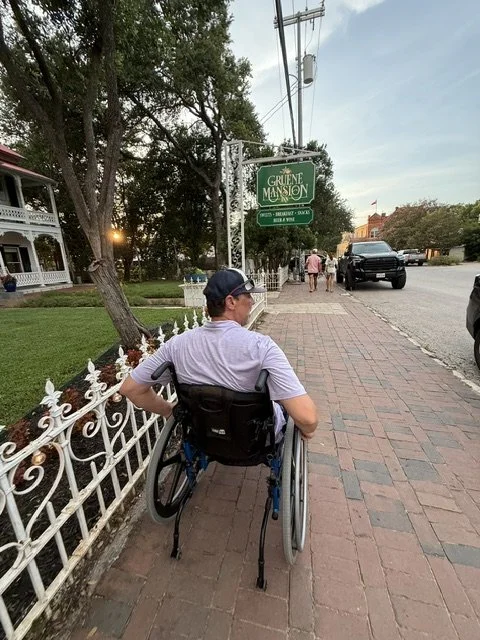
Rob rolling along in Gruene, Texas
Nothing is more important to Rob and I than physical and mental strength.
Rob and I work out hard. We have a very consistent workout schedule, and we both lift a lot of weights. For Rob it’s about maintaining his mobility. It’s about remaining as strong as he can for as long as he can. For me, I feel the weight of doing a lot of hard things around the house and being there for Lucy physically. If I don’t work out and maintain my health who will be there for her? Frankly, it’s a lot of pressure and it’s hard for both of us. Thankfully, working out makes the best version of us! So we keep doing it.
Mental Health
Then there’s the strength of our mental health. While both Lucy and I have sought counseling in the last two years to work through Rob’s disability - it’s not something Rob has done - yet.
Regardless, we know that living with a disability and being in an inter-abled couple relationship takes a lot of hard work on the mental side. We’ve spent a lot of time focused on what we have and not what we have lost. What we can do and not what is holding us back. I push Rob to travel and on a simpler level, get out of the damn house. I remind him that I love him NO MATTER WHAT and that the only thing holding us back is our own head.
All this to say, I am a huge fan of therapy and getting the help you need to manage through a life-changing diagnoses. I’m not a doctor but I know intimately the weight of being a caregiver and cheerleader to someone with a spinal cord injury. It’s A LOT! And while I can’t pretend to even have a small understanding of what the last three years have been like for Rob - I can imagine the weight he carries as well. Below are some really good organizations that can help families manage and ultimately thrive! We hope it’s some help and please send any organizations we may not know of. We are still learning. (Disclosure: AI helped curate this list)
General Disability & Accessibility Resources
The Arc – Supports people with intellectual and developmental disabilities and their families, with local chapters offering advocacy and services (thearc.org)
Easterseals – Provides disability services, including therapy, equipment loans, and family support (easterseals.com)
National Disability Rights Network (NDRN) – Connects families to state-based Protection & Advocacy agencies for legal and accessibility support (ndrn.org)
Family Voices – A national network run by and for families of children with disabilities or special healthcare needs (familyvoices.org)
United Cerebral Palsy (UCP) – Despite the name, serves a broad range of disabilities with local affiliates offering therapy, housing, and equipment help (ucp.org)
Wheelchair-Specific & Mobility Resources
Wheelchairs 4 Kids and similar regional groups – Provide free or low-cost wheelchairs and adaptive equipment to families in need
Free Wheelchair Mission – Donates wheelchairs to people with mobility disabilities, domestically and internationally (freewheelchairmission.org)
United Spinal Association – Peer support, advocacy, and resources for wheelchair users and people with spinal cord injuries/disorders (unitedspinal.org)
Christopher & Dana Reeve Foundation – Resources and a helpline (Paralysis Resource Center) specifically for families dealing with paralysis and mobility needs (christopherreeve.org)
Wheelchairs for Warriors – Focused on veterans but sometimes extends resources to other families in need
Special Olympics
Special Olympics – Year-round sports training and competition for children and adults with intellectual disabilities, plus family support programs and Athlete Leadership initiatives (specialolympics.org)
Local Special Olympics state chapters often have additional family resources, so it's worth searching for your specific state's program
Mental Health Organizations
National Alliance on Mental Illness (NAMI) – Education, support groups, and a helpline for individuals and families (nami.org, helpline: 1-800-950-6264)
Mental Health America (MHA) – Screening tools, resources, and advocacy for mental health conditions (mhanational.org)
Child Mind Institute – Focused on children's mental health, including kids with co-occurring disabilities (childmind.org)
The JED Foundation – Mental health resources especially for teens and young adults (jedfoundation.org)
988 Suicide & Crisis Lifeline – Call or text 988 for 24/7 crisis support in the U.S.
Combined Disability + Mental Health Support
National Alliance for Caregiving – Support for family caregivers, including mental health resources for caregiver burnout (caregiving.org)
Parent to Parent USA – Connects parents of children with disabilities or special needs to trained "support parents" who've navigated similar situations (p2pusa.org)